Inside a live operations hub
This is what Codified Operational Intelligence™ looks like in daily use: a fully populated hub for Alpine Mechanical Systems, a fictional 18-person mechanical contractor modelled on real client work. Fifteen modules, 125 codified pages, 9 departments. Tour it below, then open the live demo and click anything.
Name and email opens it instantly. No password, no sales call.
Thirty-six seconds through the live hub. Captioned, no sound needed.
What is an operations hub?
An operations hub is a single branded workspace where a service business runs day to day: the weekly management dashboard, the scorecard, the codified processes and standards, job and schedule tracking, estimating, safety records, training, and the company goals, all in one place the whole team actually uses. It is the finished product of the ControlShift™ method, and it replaces the scattered mix of spreadsheets, group chats, binders, and knowledge stuck in people's heads that most trades businesses run on.
Businesses forget. We codify.™ The hub is where the codified knowledge lives, stays current, and gets used, which is the difference between documentation that works and a binder that gathers dust.
Everything below is a real screenshot from the live demo. Alpine Mechanical Systems is fictional and every number is synthetic, so the figures are illustrative rather than client results. The structure is exactly what we build.
What's inside the demo hub?
Fifteen modules, one login, the whole business. Here are the six that tell the story fastest.
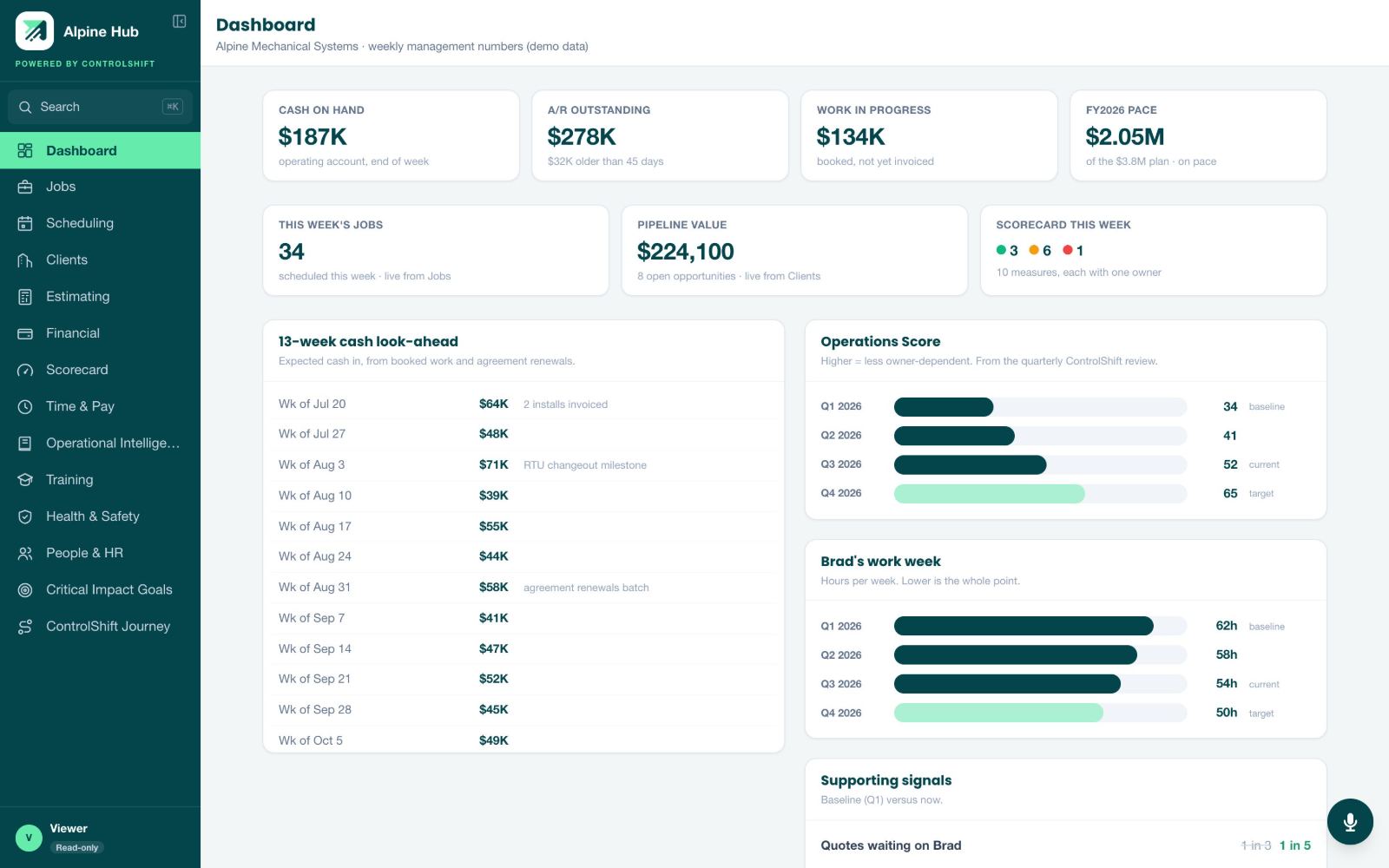
Dashboard: the Monday morning number
Cash on hand, receivables, work in progress, and pace against the annual plan, above a 13-week cash look-ahead. Beside it, two numbers most dashboards never show: the Operations Score trending quarter by quarter, and the owner's hours per week trending down. That second one is the whole point of the work.
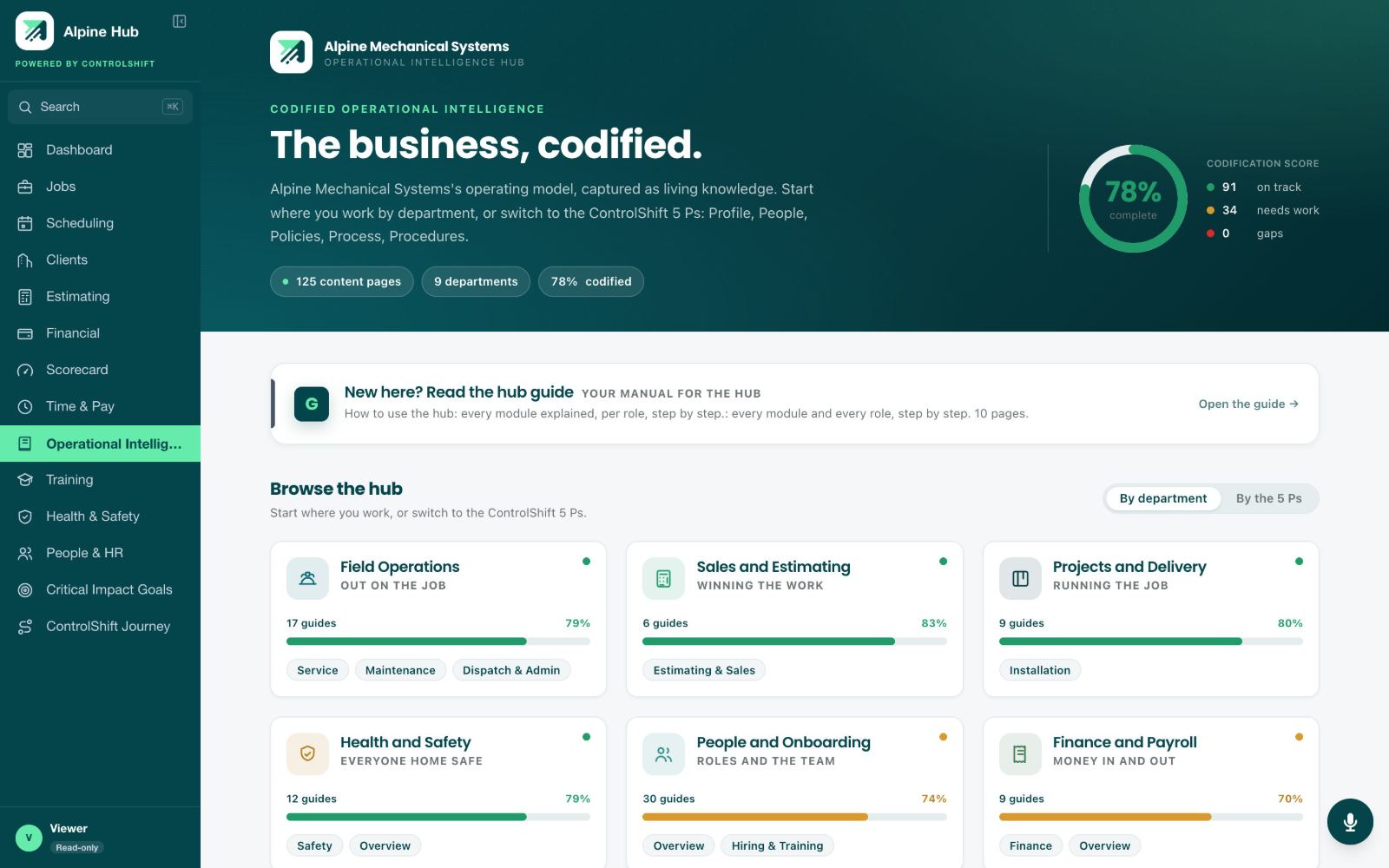
Operational Intelligence: the business, codified
The heart of the hub, and the reason the rest of it works. 125 codified pages across 9 departments, with a codification score showing what is on track and what still needs work. Browse by department, the way people actually think about their job, or switch to the ControlShift 5 Ps: Profile, People, Policies, Process and Procedures. Process holds the clickable swim-lane maps; Procedures holds the step-by-step SOP library each map step links into.
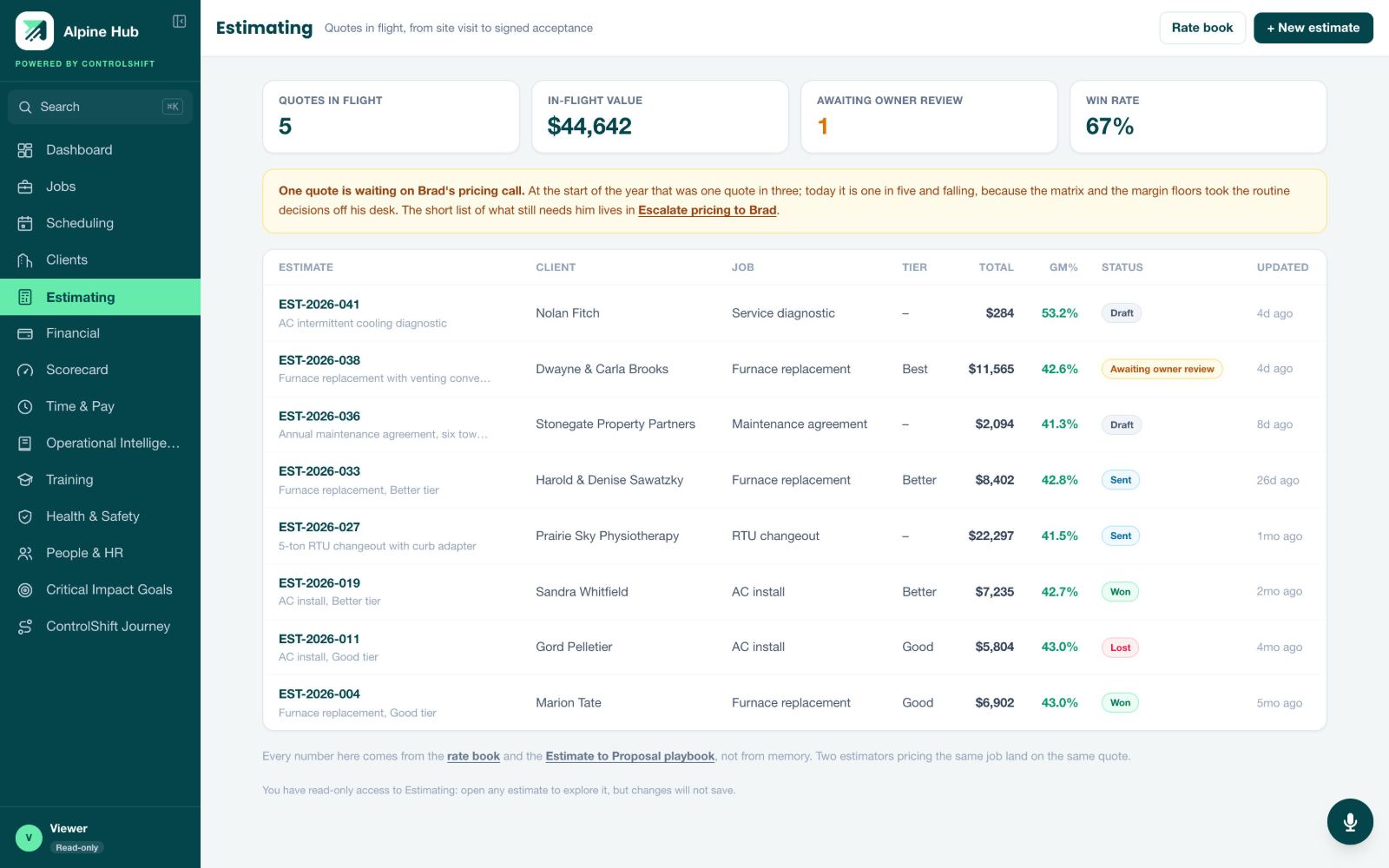
Estimating: two estimators, one number
Pricing comes out of the rate book and the documented estimate-to-proposal process, not out of somebody's memory. That is what codification buys you: two estimators pricing the same job land on the same number, and the owner stops being the final say on every quote.
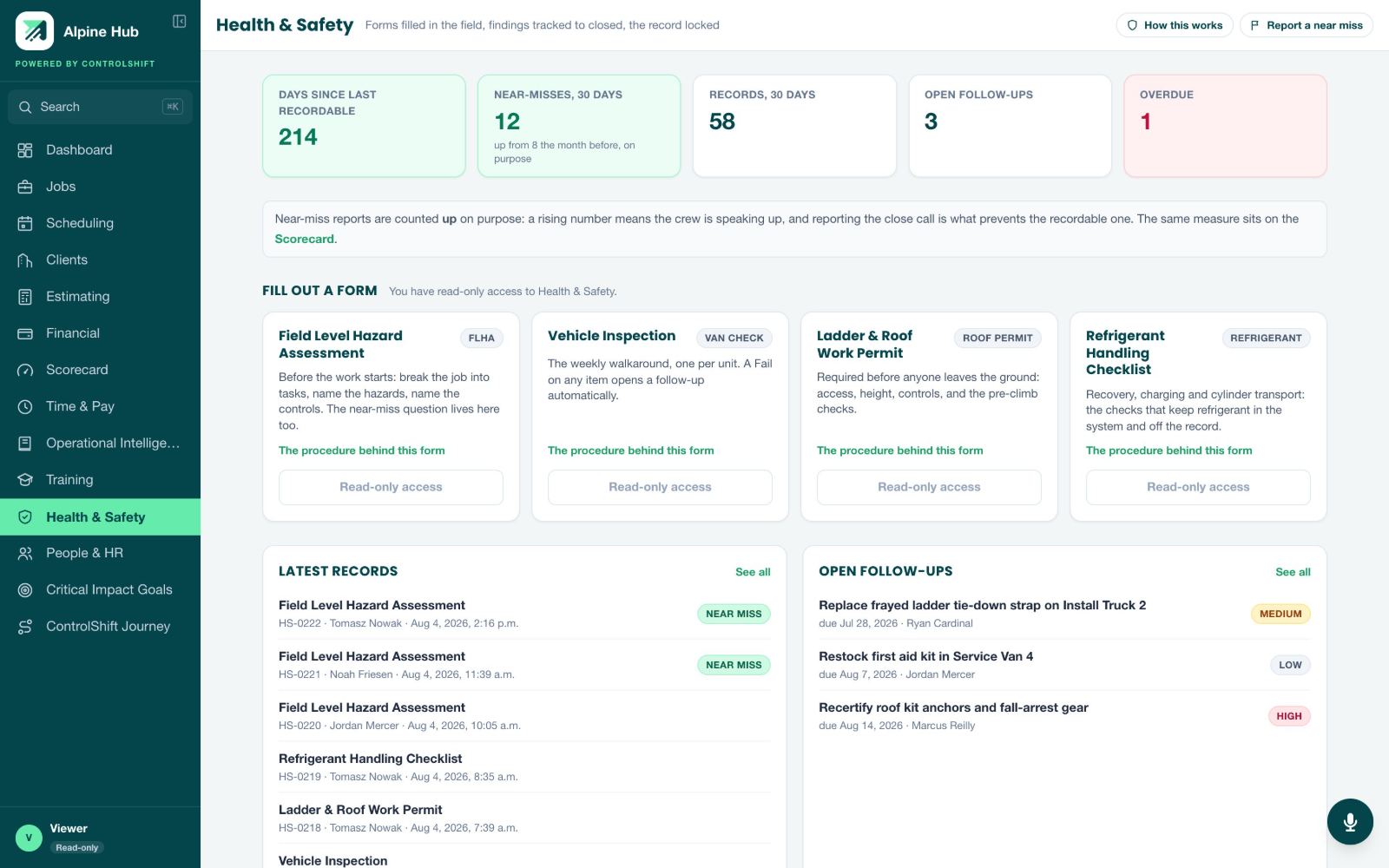
Health & Safety: the paperwork that protects you
Field level hazard assessments, vehicle inspections, ladder and roof permits, refrigerant handling, toolbox talks, and open follow-ups, all filed and findable. Note the framing on near misses: a rising count is treated as good news, because it means the crew is speaking up, and the reported close call is the recordable that never happened.
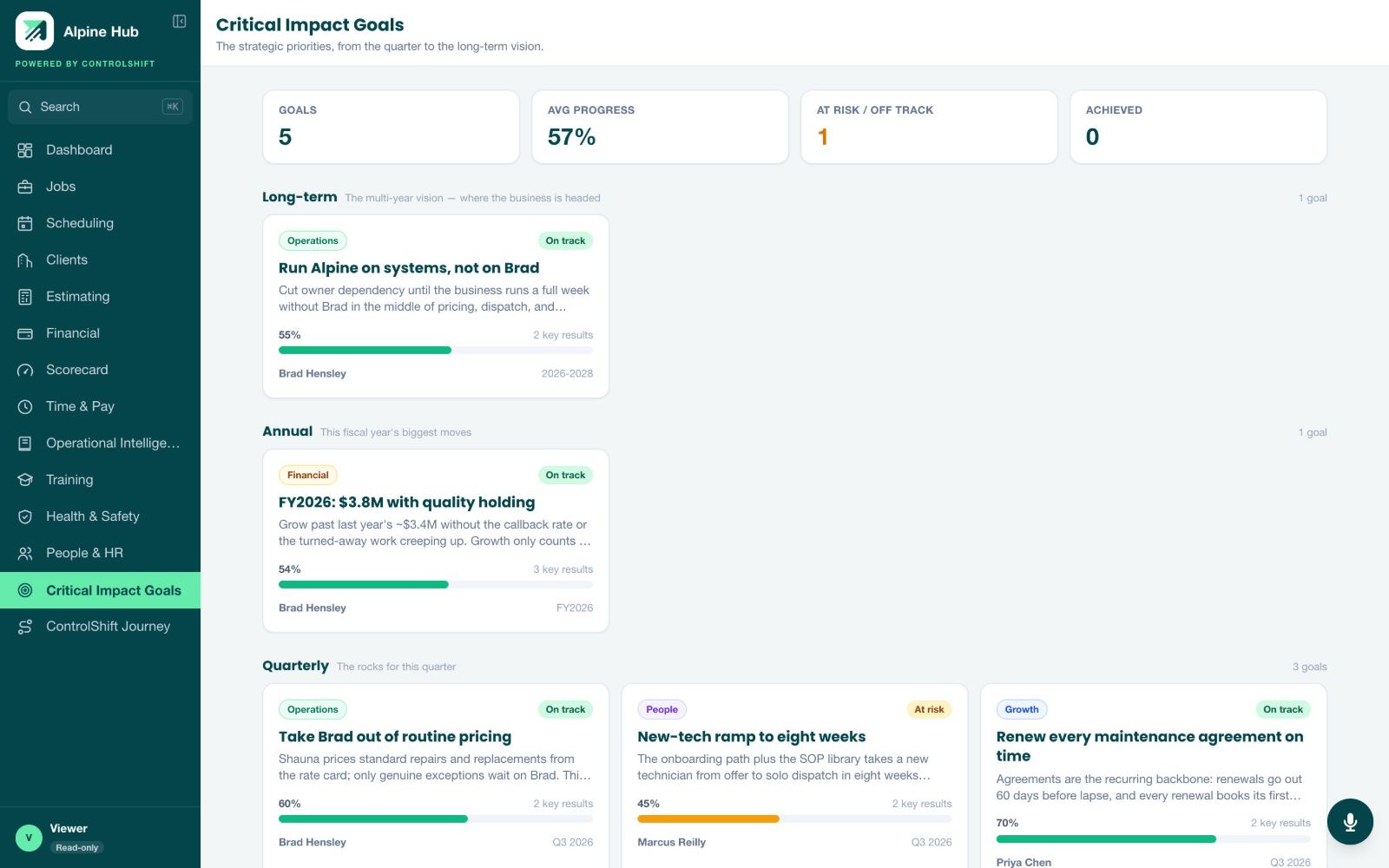
Critical Impact Goals: the plan that survives the quarter
Long-term intent at the top ("run Alpine on systems, not on Brad"), the annual number under it, then the quarterly priorities that actually move it: take the owner out of routine pricing, get new-tech ramp down to eight weeks, renew every maintenance agreement on time. Each one has an owner, so the plan gets checked instead of filed.
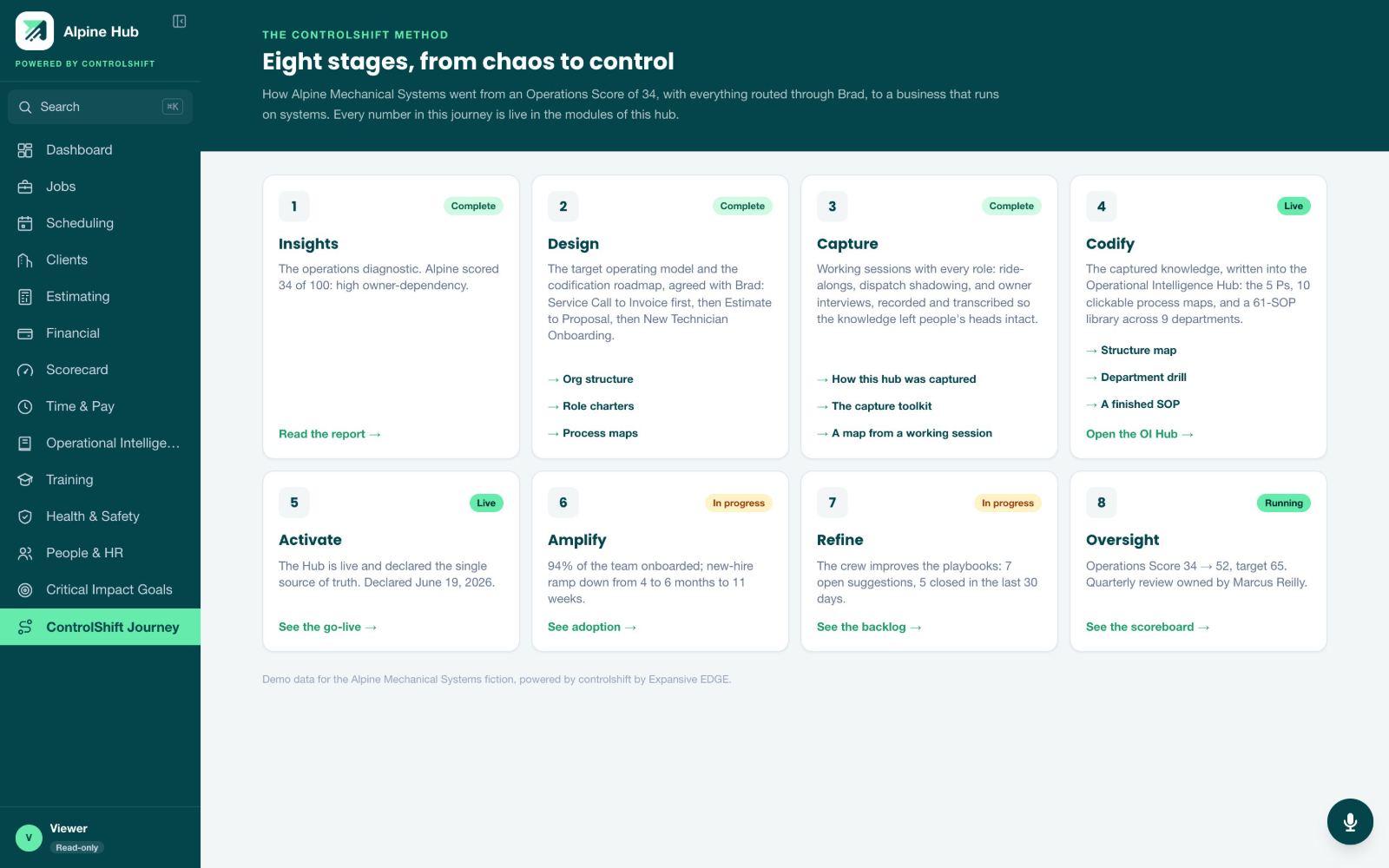
The ControlShift Journey: how the hub got built
The module to study if you want to understand the work from the inside before you ever talk to us. All eight stages with their status, and the story they tell: an operations diagnostic scoring 34 out of 100 with everything routed through the owner, working sessions with every role, the knowledge written into the hub, then go-live and adoption. Every number in the journey links to the module where it lives.
The rest of the operation
The hub is not a document library with a dashboard bolted on. It is where the work is actually run.
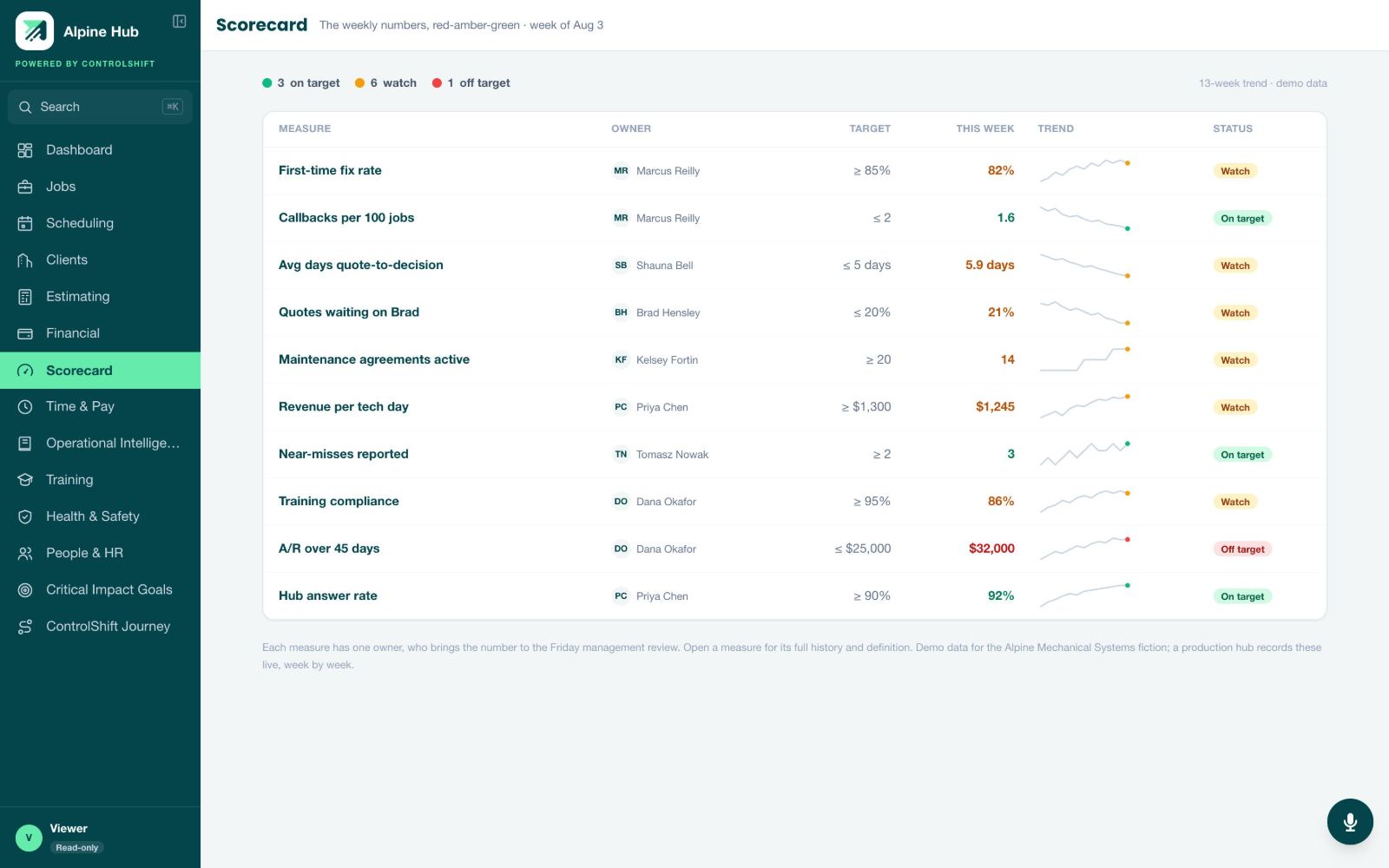
Scorecard
Ten measures, each with exactly one owner who brings the number to the Friday review. Open any measure for its history and its definition, so nobody argues about what it means.
Jobs
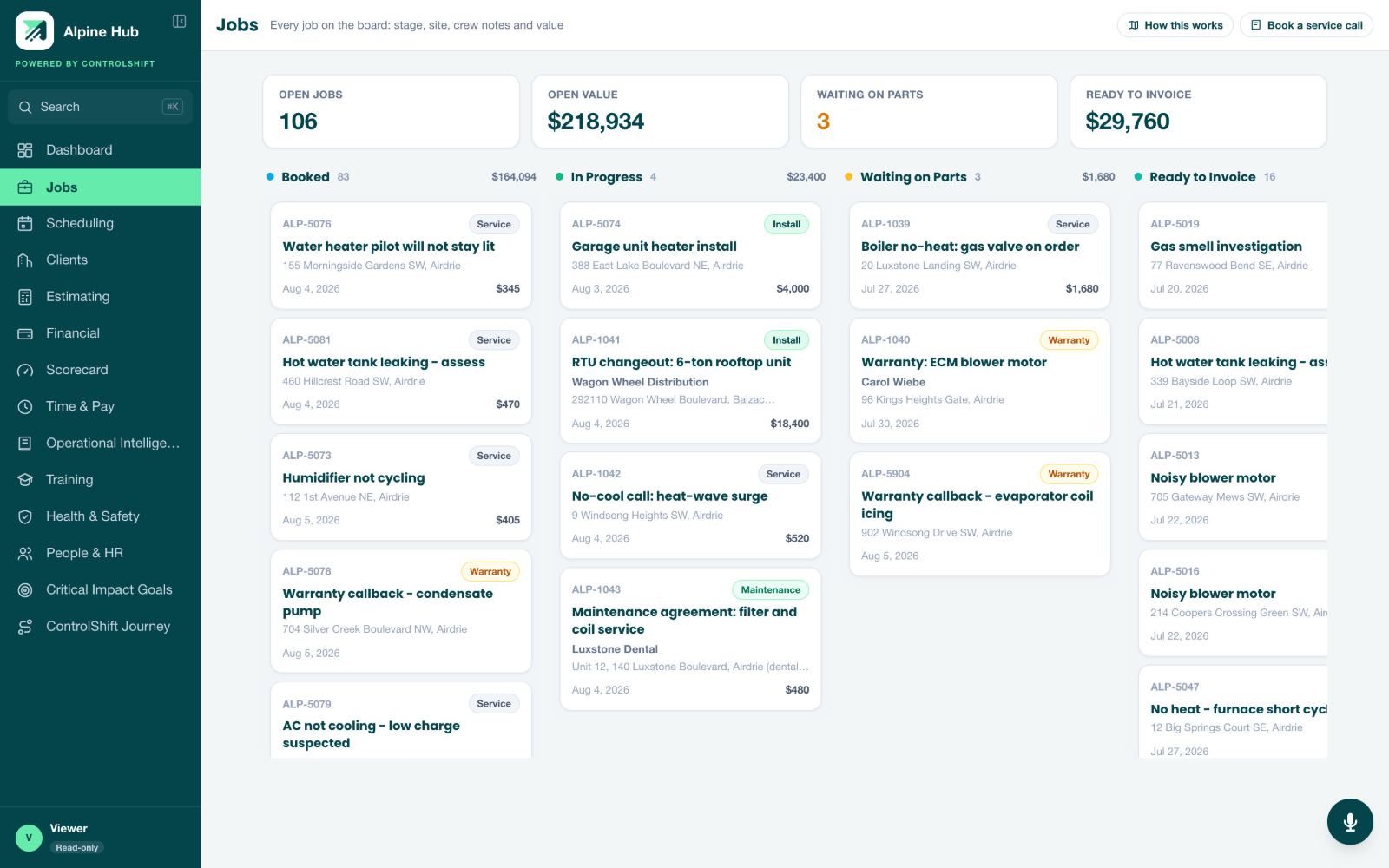
Live job board from booked through complete: no-heat calls, warranty callbacks, tank leaks, defrost faults, all with the address and the history attached.
Scheduling
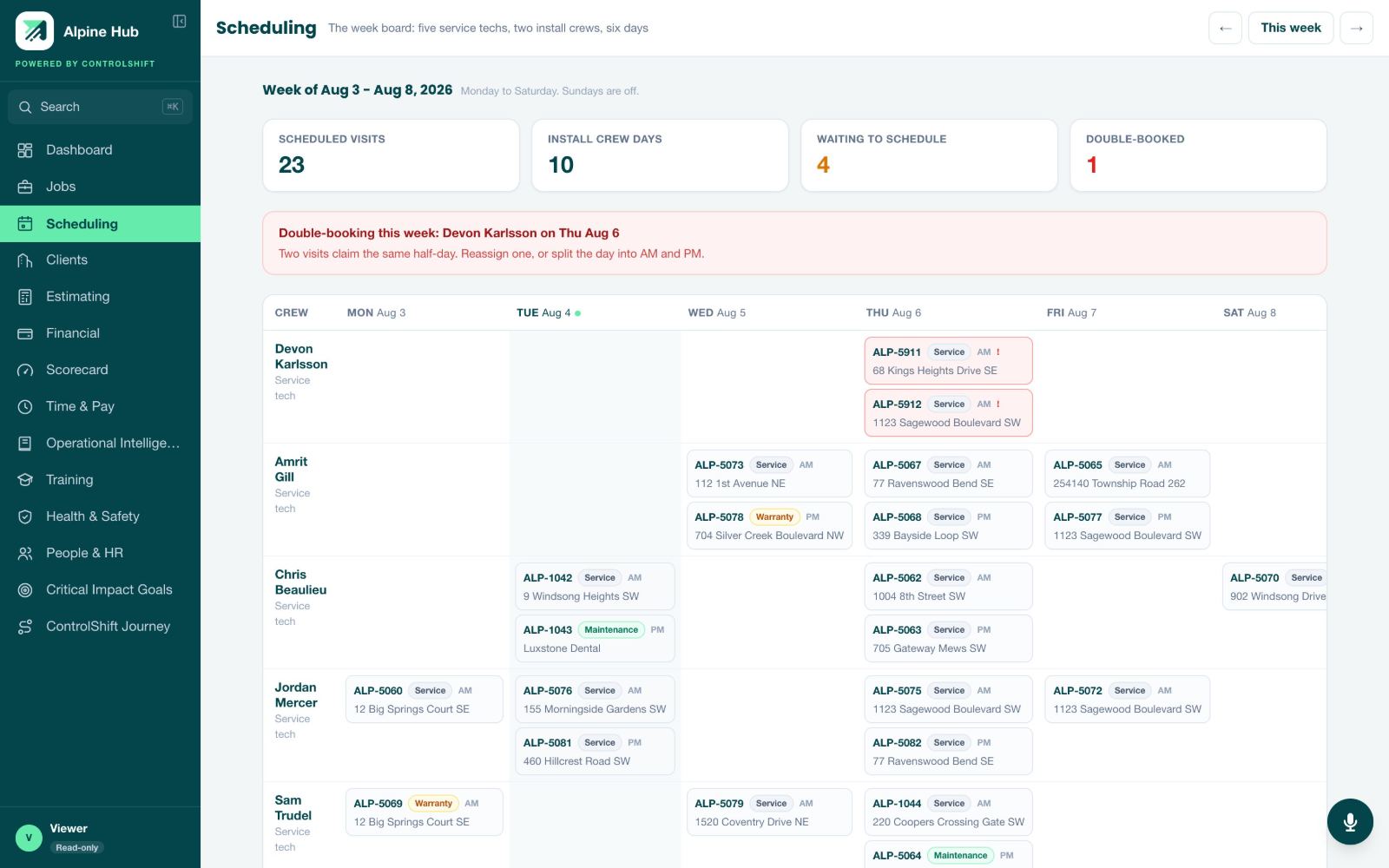
The week at a glance with the unscheduled queue beside it, and conflicts called out in plain language: it flags the double-booking before the customer does.
Financial
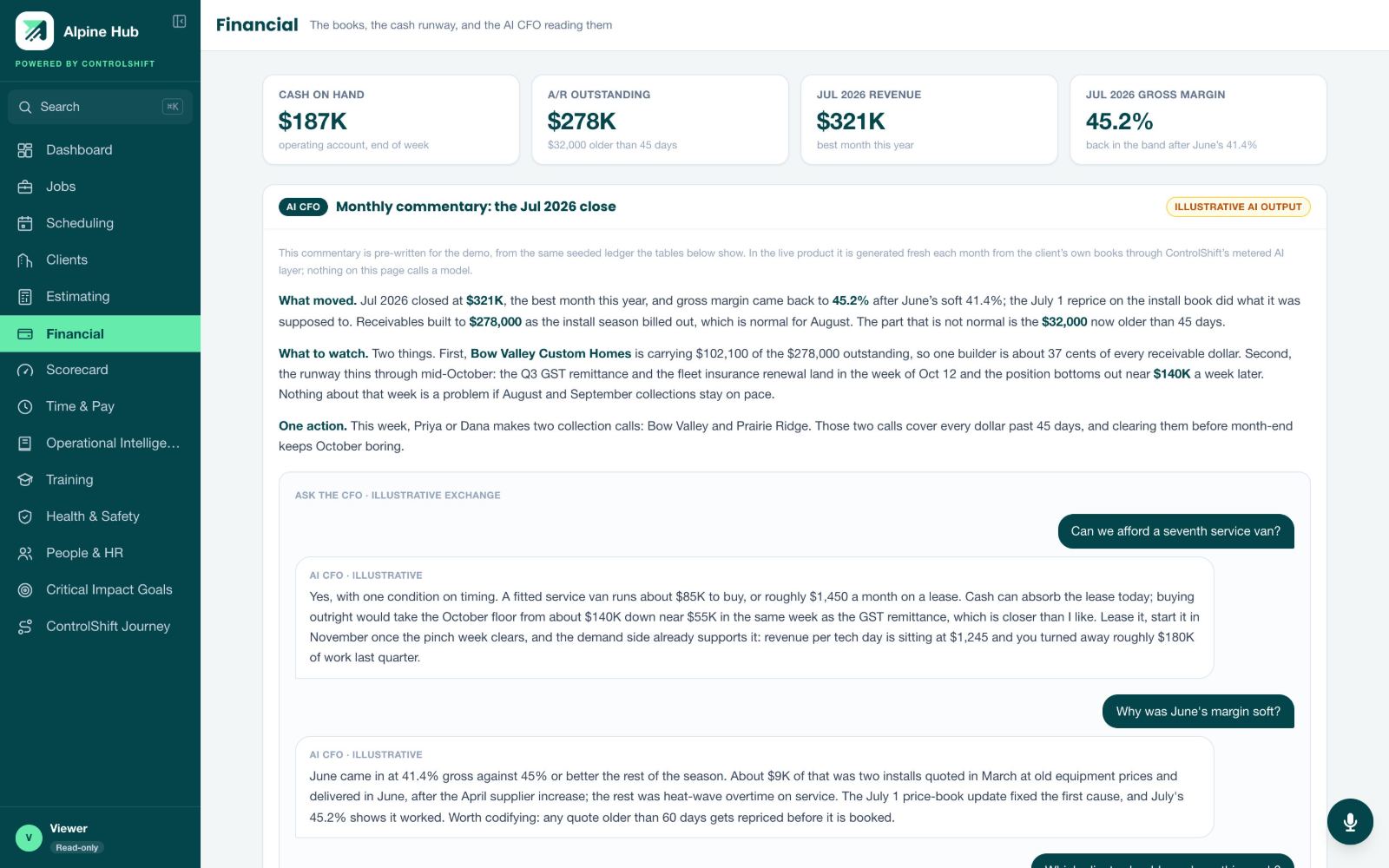
Monthly close commentary, trailing twelve-month profit and loss, where revenue comes from, receivables aging, and job-level profitability. The month explained, not just tabulated.
Training
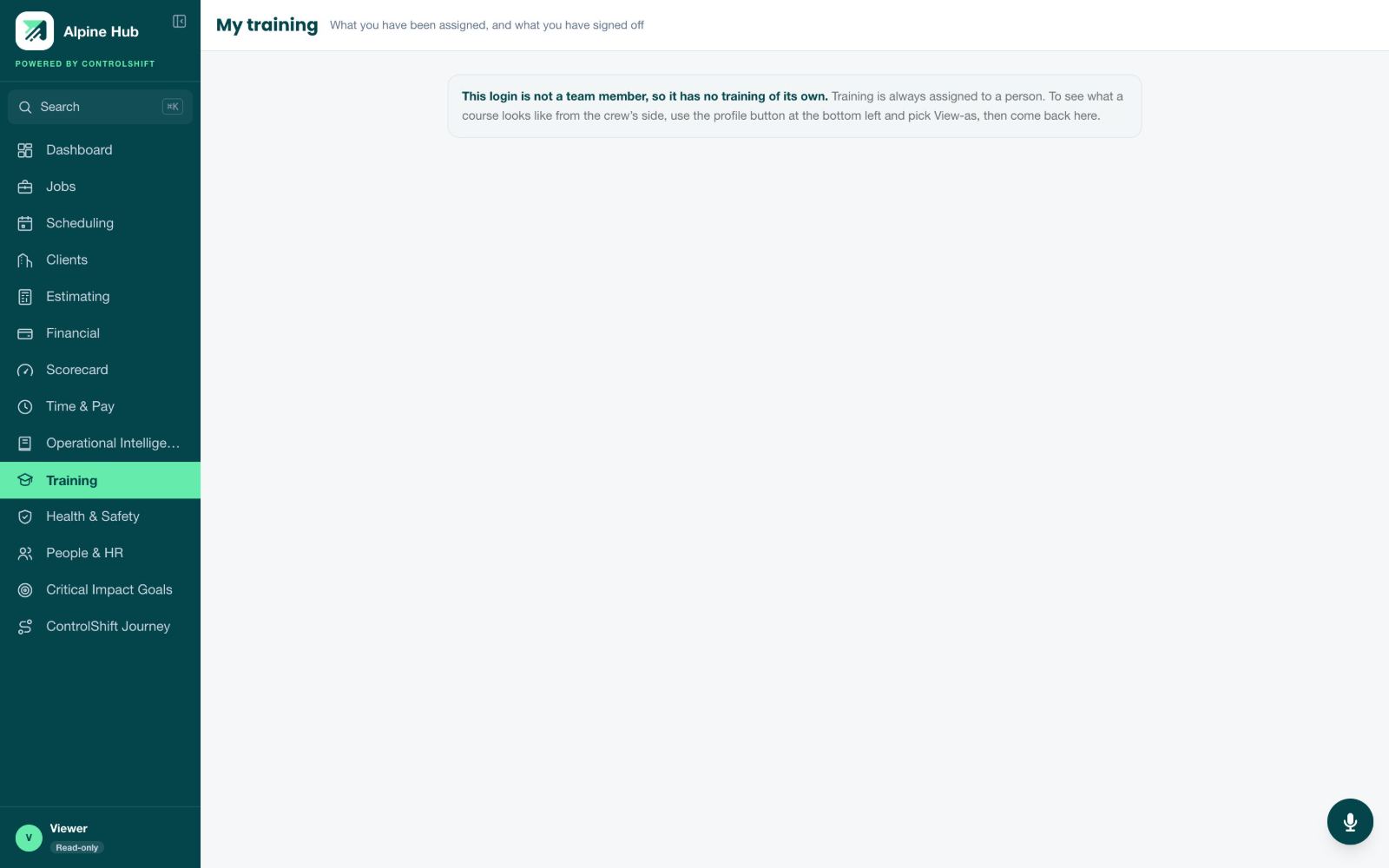
Courses assembled straight from the codified pages, assigned by person and role, with end-of-course sign-off and an audit record. Your documentation becomes your onboarding without anyone rewriting it.
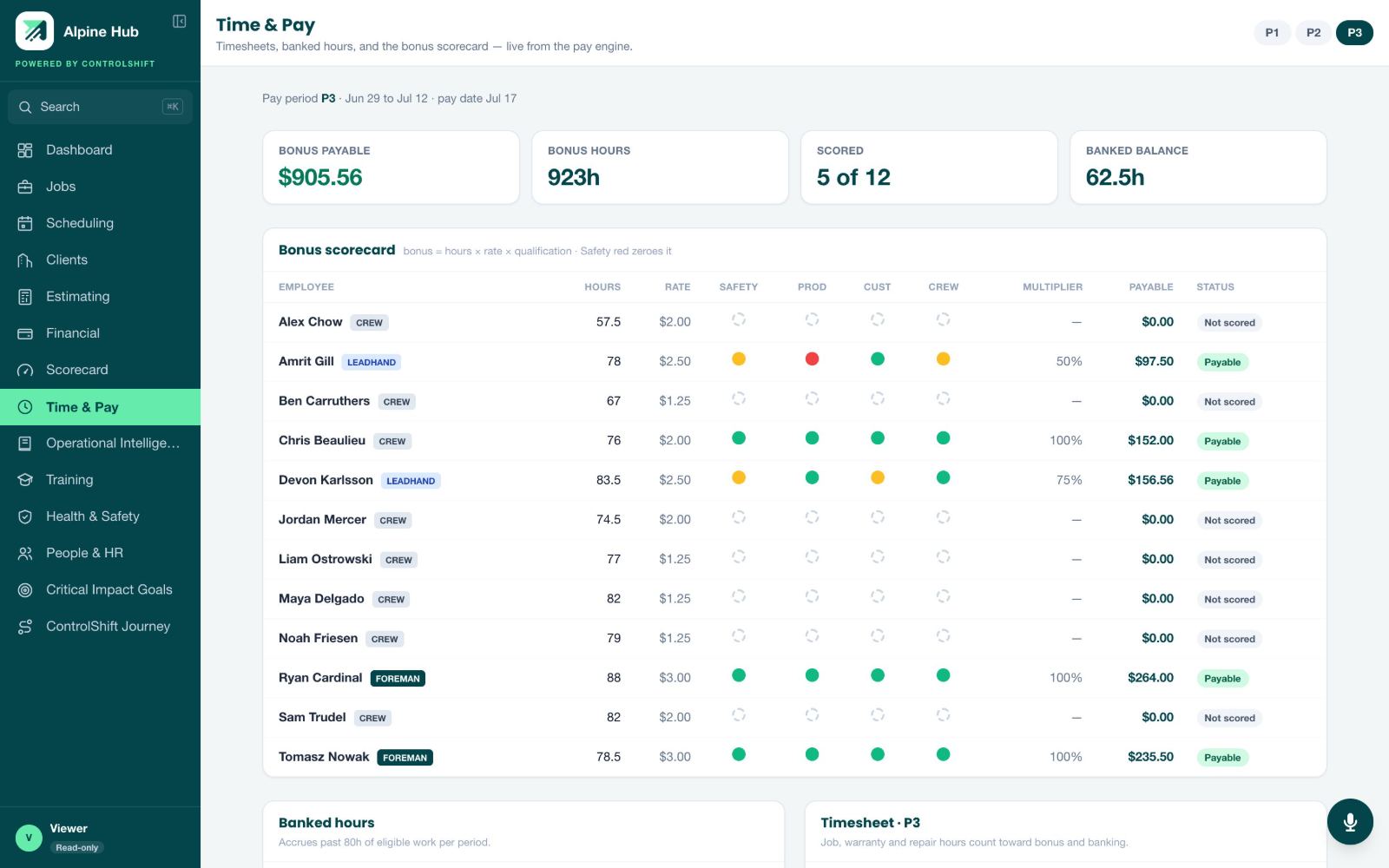
Time & Pay
Timesheets, banked hours and the bonus scorecard, running off the same pay rules the crew can read for themselves. Fewer payroll arguments, because the rule is written down.
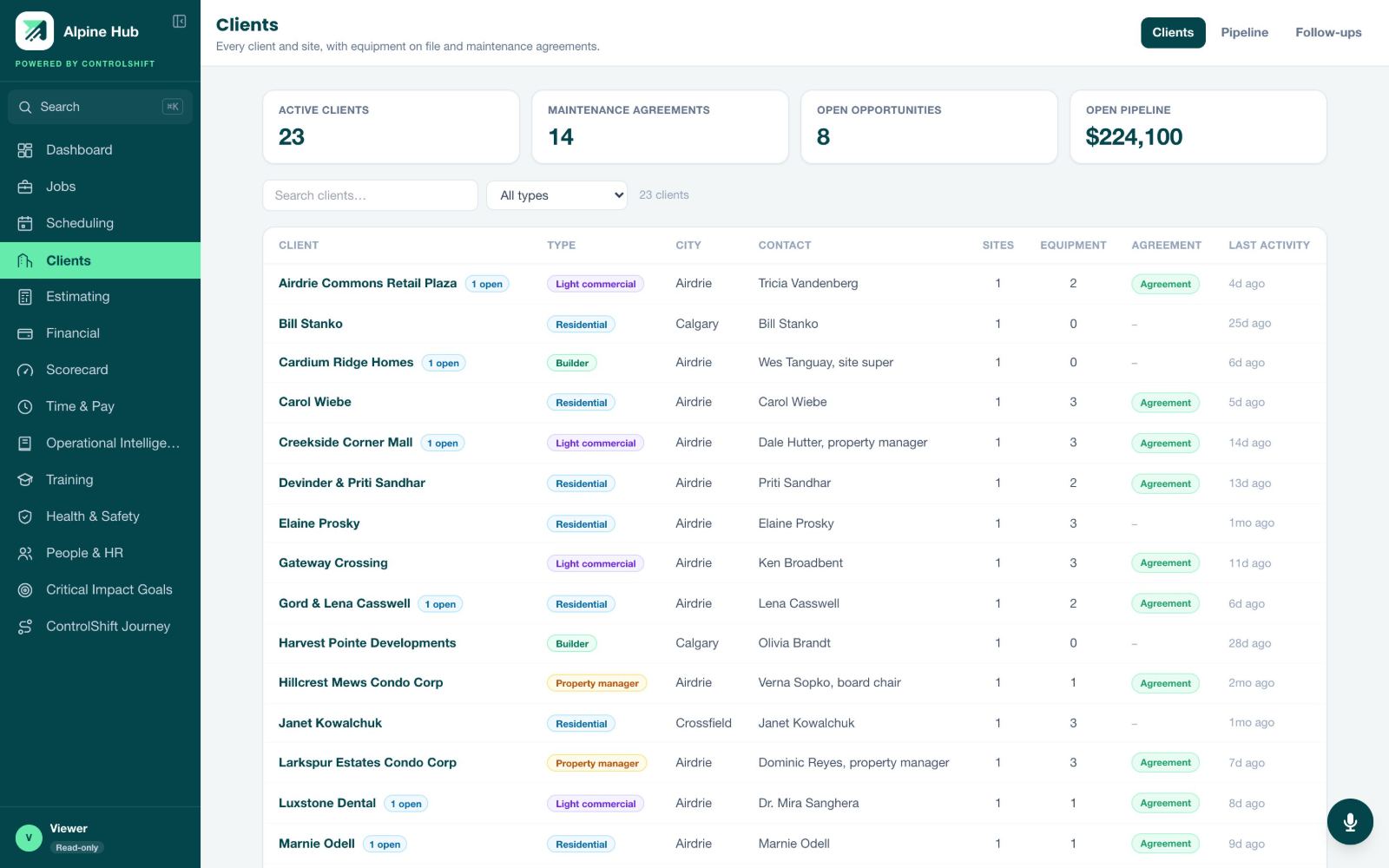
Clients
Every client and site with the equipment on file and the maintenance agreements attached, so the tech arriving knows what is already in the building.
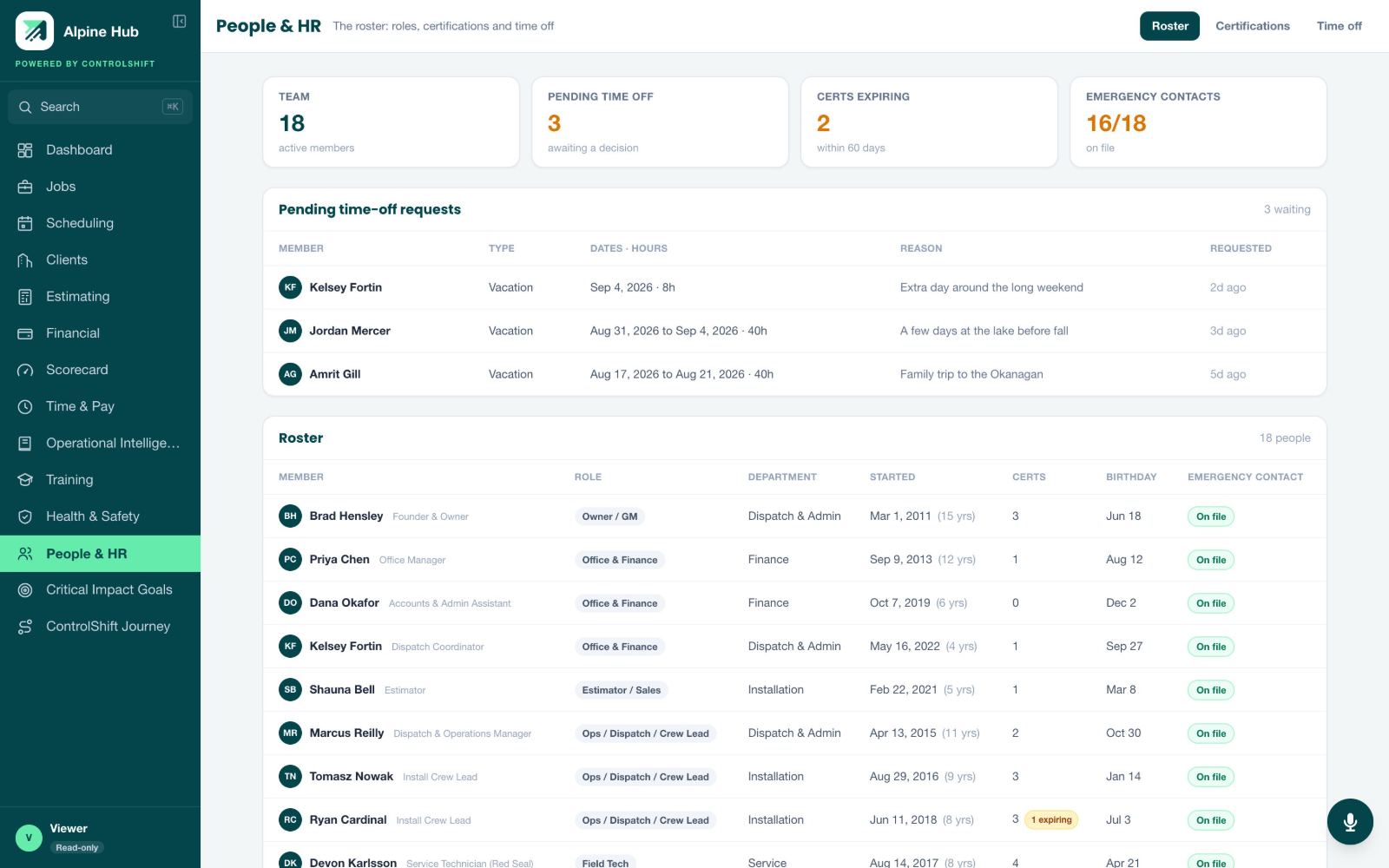
People & HR
Roster, time-off requests, anniversaries. Built privacy-first on purpose: birthdays show month and day only, and emergency contacts appear as a flag while the details stay in the office records.
How is this different from a wiki or an intranet?
Three ways. First, it's codified, not collected: a wiki is wherever people happened to write things down. A hub is the deliberate, organized output of pulling knowledge out of heads through structured working sessions, with the reasoning attached, not just the steps.
Second, it's operational, not archival: the dashboard, the scorecard, the jobs, the schedule and the goals live beside the documentation, so the team opens the hub to work, not to look something up once a quarter. Documentation nobody opens is a binder with a login.
Third, it's built for you and owned by you: we build it through the ControlShift engagement, and it belongs to your business from day one. When the engagement ends, the hub stays, and so does everything in it. If your team already lives in Trainual, Whale, Notion or SharePoint, we can build there instead, but this is the default.
Want the method behind it? Read the 8 stages of ControlShift, or the Codified Operational Intelligence category page.
Before you open it
Is the demo a real company?
No. Alpine Mechanical Systems is fictional and every number in it is synthetic. The hub is real and fully populated, modelled on real client work at the operating depth of an 18-person mechanical contractor. The structure is exactly what we build; the numbers are illustrative and are not client results.
Do I need to give my email?
Yes. A name and email opens the full demo instantly, with no password and no sales call. You'll get a short guided tour by email, and you can unsubscribe with one click.
Do we own the hub, or rent it?
You own it. It's built for your business and belongs to your business, not a seat on someone else's platform. The content inside it is yours too.
How does one get built for us?
Through ControlShift, our 8-stage method. The core codification work is done for you over roughly 16 weeks: structured working sessions pull the knowledge out of your team's heads, and it comes back as an organized, usable hub. Phase 2 deploys it into daily work.
What does it cost?
Hubs are delivered inside ControlShift codification engagements, from $15,000 CAD for a 16-week Phase 1. Most owners start earlier and cheaper: the free Owner Dependency Score, or the $997 ControlShift Insights Assessment.
See it for yourself
Fifteen modules, fully populated, read-only. About ten minutes to walk properly. A name and email opens it, and you can unsubscribe from the tour emails with one click.
Want the diagnostic instead of the tour? The $997 ControlShift Insights Assessment scores your business across the 5 Ps and comes back as a personalised 60+ page report.